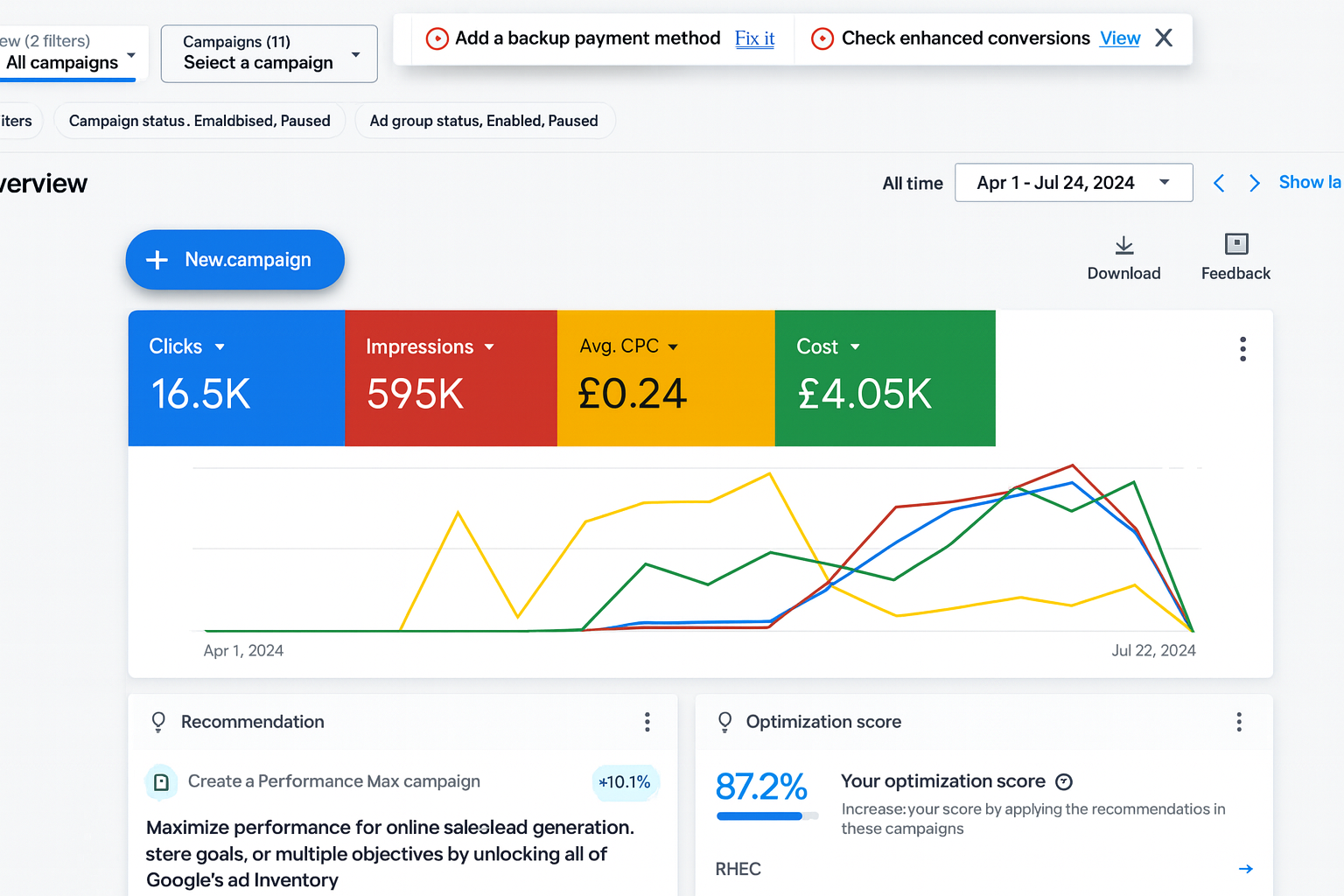
Selling products through Google Shopping can bring highly targeted buyers to an online store. When someone searches for a product on Google, they often see product images, prices, and store names directly in the search results. These listings are powered by Google Merchant Center and promoted through campaigns inside Google Ads.
Many store owners focus on product feeds and images, but bidding strategy plays an equally important role. The bidding method determines how aggressively your products compete in auctions and how efficiently your advertising budget is used.
Choosing the right strategy can mean the difference between profitable sales and wasted spend.
Understanding bidding does not require advanced marketing knowledge. Even beginners can learn the core ideas with a simple explanation.
How Google Shopping Bidding Works
Every time someone searches for a product, Google runs a real-time auction.
Multiple stores may sell the same item. Google decides which products appear in the results and in what order.
Three main factors influence this decision:
• Your bid amount
• Product data quality
• Expected click-through performance
Your bid tells Google how much you are willing to pay for a click. Higher bids can increase visibility, but they do not guarantee success if the product data is weak.
This is why bidding strategy must work together with optimized product feeds.
Manual CPC: Full Control for Beginners
Manual cost-per-click bidding is the simplest starting point for many stores.
With this method, you decide the maximum amount you are willing to pay for each click.
Inside Google Ads, advertisers can adjust bids for individual product groups. This allows precise control over which products receive more budget.
Manual bidding is useful when:
• A campaign is new
• There is little conversion data
• You want to test product performance
For example, if a product sells well, you can increase its bid to gain more impressions.
If another product gets clicks but no sales, lowering the bid can reduce wasted spend.
Manual CPC requires more monitoring, but it gives complete control.
Enhanced CPC: Smart Support for Manual Bidding
Enhanced CPC is a hybrid approach.
You still set manual bids, but Google can automatically adjust them during auctions if the system predicts a higher chance of conversion.
This small level of automation helps improve performance while keeping most of the control in the advertiser’s hands.
Many stores move to Enhanced CPC after running manual bidding for a short time.
It works best when conversion tracking is already configured correctly.
Maximize Clicks: Fast Traffic Generation
Some merchants want quick visibility and traffic.
The Maximize Clicks strategy tells Google Ads to automatically adjust bids to generate the highest number of clicks within the daily budget.
This strategy is often used during the early testing stage when advertisers want to understand:
• Which products attract interest
• Which search terms trigger impressions
• Which listings receive clicks
However, more clicks do not always mean more sales. Because of that, Maximize Clicks is usually considered a short-term strategy rather than a long-term solution.
Target ROAS: A Data-Driven Strategy
Target Return on Ad Spend, often called Target ROAS, is one of the most powerful bidding strategies for Shopping campaigns.
With this method, advertisers tell Google how much revenue they want to earn for every dollar spent on ads.
Example:
If the target ROAS is 500 percent, the goal is to generate five dollars in sales for every one dollar spent on ads.
Google’s machine learning system then adjusts bids automatically to reach that goal.
Target ROAS works best when a campaign already has consistent conversion data.
Without enough historical data, the algorithm may struggle to optimize bids.
Maximize Conversion Value
Another advanced strategy focuses on revenue instead of clicks.
Maximize Conversion Value automatically increases bids when Google predicts that a click is likely to generate higher purchase value.
This strategy is useful for ecommerce stores with many product prices.
Expensive items often require stronger bids because each sale produces more revenue.
By focusing on total value rather than number of conversions, this strategy can help increase overall profit.
Product Segmentation Improves Bidding Performance
Even the best bidding strategy struggles if all products are grouped together.
Smart advertisers divide products into smaller groups.
Segmentation can be based on:
• Product category
• Price range
• Brand
• Profit margin
• Best-selling items
For example, a high-margin product can handle a higher bid, while low-margin products may require stricter cost control.
This structure allows bidding strategies to perform more accurately.
Data Quality Still Matters
Bidding alone cannot fix weak product listings.
Google relies heavily on product feed quality stored in Google Merchant Center.
Strong product data includes:
Clear product titles
Detailed descriptions
High quality images
Accurate pricing
Valid product identifiers
Better product information helps Google match listings with the right searches.
That improves click-through rates, which often lowers advertising costs.
When to Change Your Bidding Strategy
Many advertisers make the mistake of switching strategies too quickly.
Google’s system needs time to learn.
Before changing a strategy, campaigns should usually run long enough to collect meaningful data.
A practical approach looks like this:
Start with Manual CPC
Gather performance data
Move to Enhanced CPC or automated bidding
Scale with Target ROAS or Maximize Conversion Value
This gradual progression helps campaigns remain stable while improving performance.
Common Bidding Mistakes in Google Shopping
Several mistakes repeatedly appear in underperforming campaigns.
Setting bids too high without sales data can drain budgets quickly.
Using automated strategies without conversion tracking makes optimization impossible.
Changing bids every day prevents Google from learning campaign behavior.
Grouping all products together hides valuable performance insights.
Avoiding these mistakes can significantly improve campaign efficiency.
The Real Goal of a Good Bidding Strategy
Successful bidding is not about paying the highest price for clicks.
The real goal is balance.
The right strategy helps products appear when buyers are ready to purchase while maintaining a profitable cost level.
When bidding strategy, product data, and campaign structure work together, Google Shopping becomes a reliable channel for ecommerce growth.
Even small improvements in bidding efficiency can lead to higher visibility, lower costs, and more consistent sales.