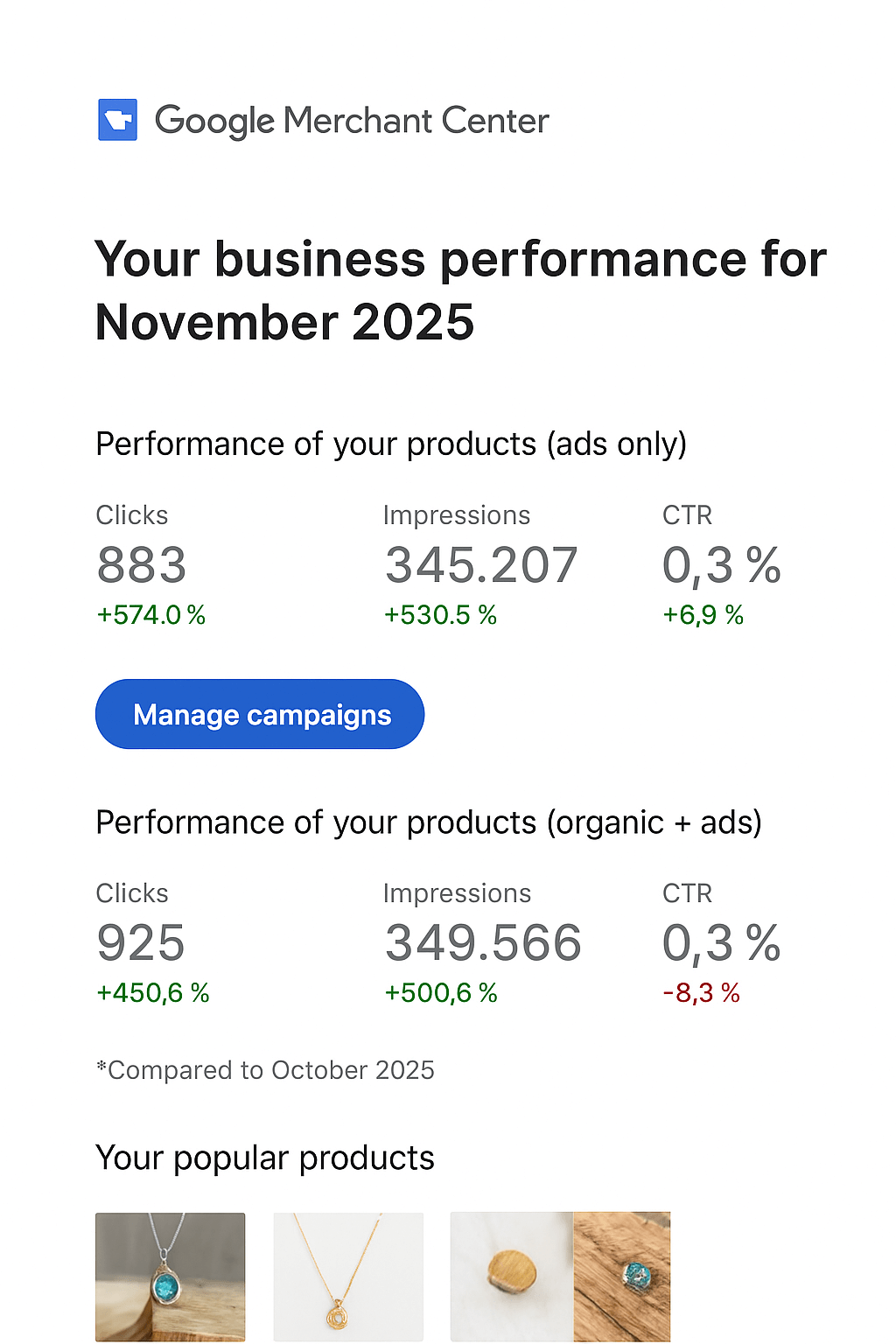
Online shoppers often decide within seconds which product they want to click. When products appear in Google Shopping results, the first signal of performance is the click-through rate, often called CTR.
CTR simply means how many people click a product after seeing it.
If 100 people see a product and 2 click it, the CTR is 2 percent.
Understanding CTR helps store owners measure whether their product listings are attractive and relevant to buyers.
For businesses running campaigns inside Google Ads with products connected through Google Merchant Center, CTR becomes one of the most important performance signals.
What CTR Means in Google Shopping
Google Shopping listings appear with images, price, and store name. Because buyers can see the product before clicking, Shopping ads often receive stronger engagement than traditional text ads.
CTR reflects how well your product listing matches what someone is searching for.
Higher CTR usually means:
• The product title matches the search query
• The image looks clear and appealing
• The price is competitive
• The product is relevant to the search
Lower CTR usually indicates that the listing does not attract attention or does not match the search intent.
Average CTR for Google Shopping Ads
CTR varies depending on product category, competition, and pricing. However, industry data shows fairly consistent patterns across major ecommerce markets.
Typical average ranges look like this:
| Country | Average Google Shopping CTR |
|---|---|
| United Kingdom | 1.2% – 2.3% |
| United States | 1.1% – 2.0% |
| Canada | 1.0% – 1.9% |
These numbers represent general averages across many industries.
Some niches perform far above these ranges.
Others remain lower due to intense competition.
Why CTR Differs Between Countries
Consumer behavior varies slightly across regions.
Market maturity, competition levels, and ecommerce adoption influence click behavior.
In the United States, product competition is extremely high. Thousands of sellers may compete for the same product searches. This sometimes reduces CTR because users see many similar listings.
In the United Kingdom, online shopping adoption is very strong, which can increase engagement with Shopping ads.
In Canada, the market is slightly smaller, and competition is usually less intense than in the US. However, product selection can also be smaller, which affects click patterns.
Product Category Influences CTR
Different product categories produce different engagement levels.
For example, visually appealing products often attract more clicks.
Fashion, furniture, and home décor usually generate higher CTR because images strongly influence purchasing decisions.
Products with technical specifications, such as electronics or tools, may receive lower CTR because buyers often compare several listings before clicking.
Even within the same country, CTR may vary widely between categories.
Product Image Quality Matters
The product image is usually the first element that buyers notice.
Clear images with proper lighting and simple backgrounds attract attention faster.
Listings with blurry images or cluttered backgrounds often struggle to get clicks.
Google also requires product images to avoid promotional text, watermarks, or excessive logos.
Clean visuals help listings stand out in the Shopping results grid.
Product Titles Influence Click Behavior
The product title tells Google what the item is and helps buyers quickly understand what they are seeing.
A good title usually includes key product attributes such as brand, product type, and main feature.
Example:
Wireless Bluetooth Headphones Noise Cancelling Over-Ear
This kind of title helps Google match the listing with more search queries and improves the chance of clicks.
Short or vague titles often reduce CTR because buyers cannot quickly understand what the product offers.
Pricing Plays a Major Role
Buyers almost always compare prices before clicking.
If the same product appears from several stores, the most competitive price usually receives the most clicks.
However, price alone does not guarantee the highest CTR.
Buyers also look at:
• Seller reputation
• Product image
• Shipping speed
• Brand trust
A balanced listing with fair pricing and strong product presentation often performs better than listings focused only on price.
Device Type Affects CTR
Shopping behavior differs between mobile and desktop devices.
Mobile users scroll quickly through results and may click faster when something visually appealing appears.
Desktop users often compare multiple listings before clicking.
Because of these patterns, some campaigns see slightly higher CTR on mobile devices.
Campaign optimization inside Google Ads can adjust bids based on device performance.
How to Improve Google Shopping CTR
Improving CTR does not require complicated strategies.
Several simple improvements often produce noticeable results.
Better product titles help Google match search queries more accurately.
High resolution images attract attention faster.
Competitive pricing encourages more clicks.
Accurate product data inside Google Merchant Center ensures Google displays listings correctly.
Product segmentation also helps campaigns focus on the items most likely to receive engagement.
Even small improvements can gradually increase CTR across campaigns.
What a Good CTR Looks Like
A CTR around the industry average usually indicates a healthy campaign.
Higher numbers often appear in well-optimized campaigns with strong product demand.
If CTR falls significantly below 1 percent, it usually signals a problem.
Possible causes include weak product titles, poor images, or mismatched search queries.
Monitoring CTR regularly helps advertisers understand how buyers respond to product listings.
Final Thoughts
Google Shopping performance varies across regions such as the United Kingdom, United States, and Canada, but the core idea remains the same.
Products that clearly match search intent and look appealing receive more clicks.
CTR acts as an early signal that shows whether listings attract buyers or get ignored.
When product data, pricing, and images are optimized correctly inside Google Merchant Center and campaigns are structured properly in Google Ads, CTR gradually improves.
Over time, stronger engagement leads to better visibility, more traffic, and higher chances of sales.